


Bed height might seem like a simple measurement, but in practice it’s rarely that straightforward.
Whether reviewing a client’s existing bed or considering a new one, therapists often need to balance several competing priorities. Questions such as these are common:
-
Should the bed be lowered to reduce the consequences of a potential fall?
-
Would raising the bed improve sit-to-stand transfers?
-
Is the current height increasing manual handling risks for carers?
-
Should the bed remain at one height, or change throughout the day?
The answer to each question depends on the individual, the activity being performed and the clinical priorities at that moment. That’s why bed height is a key part of creating a safe and functional bedroom environment, and one that deserves careful clinical consideration.
Bed height should be considered across three domains
|
Person |
Environment |
Occupation |
|
|
|
Every task places different demands on bed height
Getting into and out of bed, repositioning overnight, dressing, personal care and assisted transfers each place different demands on bed height.
A higher bed height that supports an efficient sit-to-stand transfer may not be the safest height for overnight sleeping. Likewise, a lower bed height, which may reduce the severity of a potential fall, can increase the physical effort required to stand.
This is why bed height deserves regular clinical review, rather than being treated as a one-off measurement. As an individual’s function, mobility or support needs change over time, the most appropriate bed height may change as well.
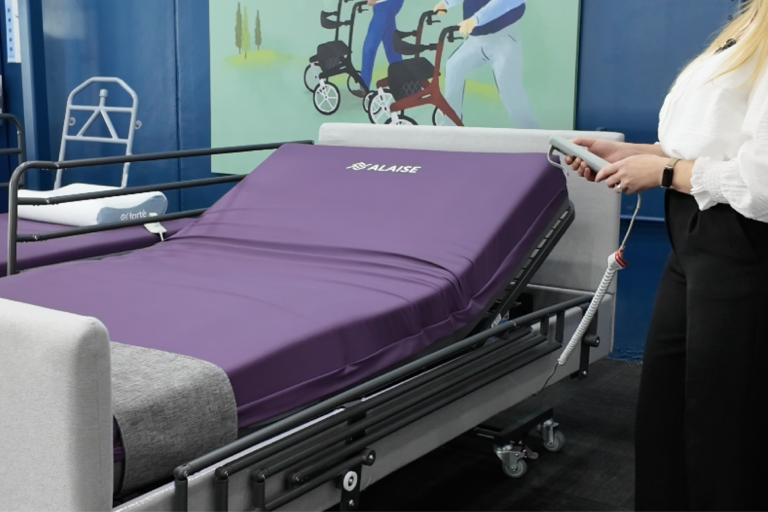
Where regular adjustment is clinically beneficial, an adjustable homecare bed can provide the flexibility to optimise bed height for different activities throughout the day.
Balancing competing clinical priorities
Every bed height decision involves trade-offs. Improving one outcome often means compromising another, which is why bed height decisions rarely have a single correct answer.
Lowering the bed reduces the distance a person may fall. From a physics perspective, a lower fall height reduces the potential energy involved in the fall, which may reduce injury severity depending on how the person lands and the surrounding environment. Martindale uses the concept of gravitational potential energy to illustrate why fall height is one factor that may influence injury severity.
However, lower is not always safer.
Very low beds can increase the physical demands of bed entry and exit, particularly for older adults with mobility challenges. Greater lower-limb effort may be required during sit-to-stand, making transfers more difficult for some individuals.
This means therapists often need to balance these competing priorities.
A lower bed may reduce the consequences of a fall, while a higher bed may better support independent transfers. Neither approach is inherently correct. The decision depends on which risks are most significant for the individual and how those risks can be balanced.
Rather than seeking a perfect height, therapists are often choosing the most appropriate compromise.
|
Lower bed height
|
Higher bed height |
|
Supports ✓ Reduced fall distance ✓ May reduce injury severity |
Supports ✓ Easier sit-to-stand transfers ✓ Less lower-limb effort ✓ Improved manual handling
|
|
Consider
|
Consider
|
Clinical tip
Think beyond “high” or “low”.
Ask what risk the chosen bed height is intended to address. A height selected to reduce injury risk from a fall may differ from one intended to maximise transfer independence or reduce manual handling demands.
Popliteal height is a starting point, not the answer
Popliteal height is commonly used as a practical starting point when determining transfer height. Measuring from the floor to the underside of the knee while sitting provides an initial guide for positioning the mattress so the person’s feet can make stable contact with the floor.
However, this measurement alone should never determine the final bed height.
Transfer performance should always be observed in practice. Factors such as lower-limb strength, trunk control, footwear, mattress compression, edge stability and habitual movement strategies all influence whether that starting height is effective for that individual.
While a popliteal measurement provides a useful starting point, functional assessment determines if it’s appropriate.
Watch: Small changes in bed height can influence transfer mechanics, which is why functional assessment remains essential.
Think dynamically, not statically
Sometimes, the safest and most functional bed height is one that can change throughout the day.
For some individuals, no single bed height will suit every activity. Where this occurs, an adjustable homecare bed can allow the height to change according to the task being performed.
Different activities may call for different bed heights. For example:
-
Getting out of bed: The bed may be positioned close to the person’s popliteal height to support an efficient sit-to-stand transfer. Where appropriate, the bed can then be raised as the person begins to stand, providing additional assistance during the transfer.
-
Getting into bed: The bed may be adjusted to support a controlled stand-to-sit transfer, then lowered to make it easier for the person to bring their legs onto the bed.
-
Overnight: The bed can be positioned lower to reduce the distance of a potential fall, while still allowing it to be raised when needed during the night.
-
Personal care and daytime activities: During personal care, dressing or other daytime activities, the bed can be raised to reduce bending and awkward postures for carers, supporting safer manual handling.
Rather than relying on a single bed height, therapists can consider when different heights may better support the person’s safety, function and care needs throughout the day.
Bed height supports more than transfers
Although transfer performance often drives bed height decisions, bed height influences much more than transfers.
Appropriate height selection may also influence:
-
Confidence during bed mobility
-
Ease of repositioning
-
Participation in dressing or personal care
-
Carer safety during assisted tasks
-
Overall comfort and independence throughout daily routines.
Viewed this way, bed height becomes one component of the broader bed system rather than an isolated measurement.
When considered as part of the overall intervention, bed height helps create an environment that supports both the individual and those assisting them.
Clinical reasoning takeaway
There is no universally correct bed height.
The optimal height depends on the individual, the activity being performed and the clinical priorities at that moment. By thinking dynamically rather than statically, therapists can balance transfer performance, falls risk, injury severity and manual handling to support safer and more effective everyday function.
Further reading
The following resources informed this article and provide additional detail for therapists wishing to explore the topic further.
-
Australian Institute of Health and Welfare (2022). Falls in older Australians 2019–20: Hospitalisations and deaths among people aged 65 and over. AIHW, Australian Government.
-
Martindale D (2021) Calculating bed height for hospital patients using popliteal measurement. Nursing Times [online]; 117: 10, early online.
-
Martindale D (2022) Using gravitational potential energy to assess the risk of falls from bed. Nursing Times [online]; 118: 2, 36-39.
-
WorkSafe Victoria (2009). Transferring people safely: A handbook for workplaces (2nd ed.).
About the author
Sarah Uncle is Head of Clinical Education at ILS and leads our education program for allied health professionals, Elevate Learning. She is passionate about helping therapists build the confidence and clinical reasoning to prescribe assistive technology effectively.
Sarah holds an Occupational Therapy degree from the University of Sydney and has extensive clinical experience across acute orthopaedics, neurological rehabilitation, paediatrics and disability, including roles with Ageing, Disability and Home Care (ADHC) and the Cerebral Palsy Alliance. She has been part of the ILS team for more than six years, combining clinical expertise with deep knowledge of assistive technology to deliver practical, evidence-informed education for therapists across Australia.
Find an Elevate Learning event near you.